




October 2007 The process for sainthood of Father Stanley Francis Rother is opened with the Archdiocese of Oklahoma City convening a tribunal. Members of the tribunal are sworn in and begin the work of reviewing material from the life of Fr. Rother.
July 20, 2010 A closing Mass is held in Oklahoma City in celebration of the completion of the tribunal's work. The material is sent to the Vatican, specifically the Congregation for the Causes of Saints.
June 2012 Archdiocese of Oklahoma City receives word that the Congregation for the Causes of Saints has named an official Relator (Dr. Andrea Ambrosi) for the Cause of Father Stanley Rother. Dr. Ambrosi, the postulator for Fr. Rother's cause, prepares a Position Paper called a Positio (the distillation of all of the historical research and testimony that was painstakingly gathered to examine the course of Father Rother's life and heroic death while serving as a parish priest at the Oklahoma mission in Guatemala).
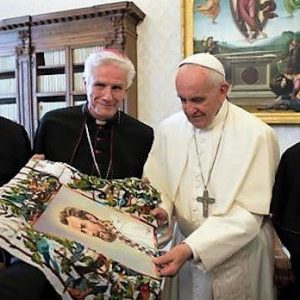
September 3, 2014 Archbishop Paul Coakley presents the Positio on the Servant of God, Fr. Stanley Rother to the Prefect of the Congregation for the Causes of Saints in Rome, Cardinal Angelo Amato.
September 11, 2014 Cardinal Amato informs Archbishop Coakley that the Congregation will begin their study of the Cause in early 2015. At the end of their study, they make a recommendation to Pope Francis.
June 2015 Theological Commission at the Congregation of the Causes of Saints in Rome votes to formally recognize Servant of God Fr. Stanley Francis Rother a martyr declaring he died odium fidei (in hatred of the faith).
December 2, 2016 Pope Francis recognizes martyrdom of Fr. Rother making him the first declared martyr of the United States.
September 23, 2017 The ceremony of the Rite of Beatification is celebrated in downtown Oklahoma City by Cardinal Angelo Amato making Fr. Rother the first priest in the United States to obtain the title Blessed.
July 28, 2018 First Feast Day of Blessed Stanley Rother is celebrated by Archbishop Paul Coakley, Archbishop Emeritus Eusebius Beltran, Abbot Lawrence Stasyszen, and clergy from the Archdiocese at Holy Trinity Catholic Church on the 37th anniversary of his martyrdom.
Archdiocese names Deacon Norm Mejstrik Director of the Cause of Canonization of Blessed Stanley Rother. He is in charge of information concerning possible miracles due to the intercession of Blessed Stanley Rother.
His contact information: 405-721-9351 Ext. 110 OR This email address is being protected from spambots. You need JavaScript enabled to view it.
Explanation of the Process of Canonization
The following article summarizes the process for becoming a Saint. As Bl. Stanley Rother’s cause is advanced through the process we will update the status here.
Beatification & Canonization
–Article taken from the USCCB website explaining the process
The process of declaring one a saint in the Catholic Church is called canonization. The canonization process is a canonical (Church law) procedure by which the Church through the Pope solemnly declares a Catholic to be united with God in heaven, an intercessory to God on behalf of the living, and worthy of public and universal veneration.
A cause of canonization examines a person’s life and death to determine if they were either martyred or lived a virtuous life. Every cause of canonization has two phases: the diocesan and Roman phase. The diocese responsible for opening a cause is the diocese in which the person died/was martyred. The diocese, religious order, association or lay person(s) requesting (petitioning) for the cause asks the diocesan bishop, through a person known as the postulator to open an investigation into the martyrdom or life of the person.
The diocesan bishop investigates how the person lived a heroic virtuous life, exemplifying the virtues of faith, hope and love through the calling of witnesses and the theological examination of the candidates’ writings. If the cause is based on martyrdom, the diocesan bishop investigates the circumstances surrounding the alleged martyrdom, which is also done through the calling of witnesses to the martyrdom and the examination of the candidates’ life.
Servant of God Fr. Stanley Rother is declared a Martyr September 2015
Once the diocesan investigation is complete, the documentation (evidence) that has been collected is sent to the Vatican’s Congregation for the Causes of Saints and the Roman phase begins. The first step in the Roman phase is the examination of the diocesan documentation. If the congregation’s theologians find the documentation convincing, it is sent for review by the cardinal and bishop members of the congregation. If they also find the documentation favorable, it is sent to the pope. With the pope’s approval a decree is issued stating that the person lived a virtuous life thereby conferring the title “Venerable”on the person.
The next step in the process is being named “Blessed.” For beatification, a miracle must be attributed to the Venerable. The miracle is verified through an examination by a team of medical experts and theologians. The three traditional standards for judging the authenticity of a miracle are: complete – meaning a total healing of the disease, it is not enough for the person to “just” feel better; instantaneous – meaning the healing occurred all at once and not over the course of several days or months; and durable – meaning the person remains permanently free from the illness that afflicted them. Once the miracle has been verified, the pope issues a decree declaring the miracle and the person receives the title of “Blessed.” The pope can dispense, though he does not always do so, from the requirement of a miracle for the beatification of a martyr.
Declared Blessed on September 23, 2017
A second miracle must be attributed to the Blessed in order for him or her to be canonized a saint. A proven miracle is required, even for martyrs, for canonization. The verification of the second miracle follows the same procedure as the first. Once the person is declared a saint, he or she is worthy of universal veneration by the Church.
There are many steps to be named a saint in the Church and the canonization process is lengthy and detailed. This process ensures that the role models held up as witnesses to Christ and the Gospel as worthy of our emulation.
Bl. Stanley Rother fact sheet from Oklahoma City Archdiocese
Born: March 27, 1935 at Rother farmhouse near Okarche, OK
• Parents: Franz Rother; Gertrude Smith Rother
• Siblings: Elizabeth Mary (Sister Marita); James Henry (dec); Caroline Ann (dec.) and Thomas Joseph (?)
Baptized: March 29, 1935 at Holy Trinity Catholic Church, Okarche by Msgr. Zenon Steber
First Communion: April 22, 1942
Confirmation: April 4, 1948
Ordained subdeacon: June 2, 1962 by Archbishop Lawrence Joseph Shehan (elevated to Cardinal 1965)
Ordained deacon: September 15, 1962 by Bishop Thomas Austin Murphy
Ordained priest: May 25, 1963, Cathedral of Our Lady of Perpetual Help, Oklahoma City by Bishop Victor Reed [Diocese of Oklahoma City and Tulsa]
Death: July 28, 1981, Santiago Atitlan, Guatemala
Education:
Holy Trinity Catholic School, Okarche (1941 - 05/53)
St. John’s Seminary, San Antonio, Texas (09/53 – 05/55)
Assumption Seminary, San Antonio, Texas (09/56 – 01/58)
Mount St. Mary’s Seminary, Emmitsburg, Maryland (09/59 – 05/63)
Southeastern State College, Durant, Oklahoma, B.S. (1965 - history)
Assignments:
Assistant Pastor, Saint William Church, Durant, Oklahoma (1963 – 1965)
Assistant Pastor, Saint Francis Xavier Church, Tulsa, Oklahoma (1965 – 1966)
Assistant Pastor, Holy Family Cathedral, Tulsa, Oklahoma (1966)
Assistant Pastor, Corpus Christi Church, Oklahoma City (September 1966 – 1968)
Catholic Mission of Oklahoma, Santiago Atitlan, Guatemala (1968 –1981), Diocese of Solola
• Pastor, Cerro de Oro (1969 – approx. 1976)
• Pastor St. James the Apostle Church, Santiago Atitlan (1975– 07/28/1981)
Mission work in Guatemala:
Father Rother served in Santiago Atitlán for 13 years. During that time, in addition to his pastoral duties, he assisted in the translation of the New Testament into the Tzutuhil language and in 1973 began to celebrate the Mass in that language. Father Rother continued his life of hard physical work, repairing the rectory, digging a well and installing its pump, repairing the church, building a parish hall and working to improve the productivity of the fincas (farms). Father Rother was also instrumental in the building of a hospital located in a neighboring canton of Panabaj between 1968 and 1970. Unfortunately, the "Hospitalito" and much of Panabaj was buried in the mudslides resulted from a hurricane with torrential rains which hit the region in October 2005. Ironically, the hurricane was named “Stan.” The hospital has now reopened.
Death threat and murder:
The political turmoil and violence in Guatemala escalated in the late 1970s and early 1980s. By December 2, 1980, Father Rother reported that a total of ten men had been taken from the area. In mid-December 1980, a catechist and leader began sleeping in the rectory after his name appeared on the death list. In his December 1980 letter to the people of the Archdiocese of Oklahoma City and the Diocese of Tulsa, Father Rother stated: “This is one of the reasons I have for staying in the face of physical harm. The shepherd cannot run at the first sign of danger.”
In early 1981 Father Rother learned that his name was on a death list. It was determined that he should leave Guatemala and he returned to Oklahoma in January 1981. However, he remained in Guatemala until he could secure a visa for his friend and fellow priest, Father Pedro Bocel. In April 1981, Father Rother returned to Guatemala. Although he was warned not to return to Santiago Atitlan, he was determined to return to continue to serve his parish. In May, Father Rother journeyed to Oklahoma to attend the ordination of his cousin, Reverend Don Wolf, but quickly returned to Guatemala. He was repeatedly warned to leave, but refused. On July 28, 1981 he was shot and killed. He was one of 10 priests murdered in Guatemala that year.
Burial:
The first funeral Mass for Father Rother was held at the church at Santiago Atitlan at 3 p.m. on Tuesday, July 28, 1981. At least twenty-five priests concelebrated the Mass, with Father Eduardo Aguirre presiding. A second Mass was celebrated at Santiago Atitlan at 9 p.m. on July 28, 1981. On Wednesday, July 29, 1981, yet another Mass was celebrated at Santiago Atitlan. Bishop Mario Rios Montt, a second bishop, and thirty-five priests concelebrated. Fr. Rother’s body was flown back to Oklahoma City and buried in his home town of Okarche. At the request of his Guatemalan parishioners, however, his heart and blood was interred beneath the floor of the parish church in Santiago Atitlán.
A memorial Mass was celebrated at Okarche Holy Trinity Church on Sunday, August 2, 1981. A standing room-only congregation participated in the funeral Mass at the Cathedral of Our Lady of Perpetual Help in Oklahoma City on August 3, 1981. Archbishop Charles Salatka presided. Father Rother’s body was buried in the family plot at Holy Trinity Cemetery, Okarche, Oklahoma, on August 3, 1981. The burial was indeed a final homecoming for Francis Stanley Rother.